



Syringe Drivers
What is a syringe driver and why are they used?
Managing symptoms, including pain, is an important part of end of life care. Each person will have different symptoms, depending on their condition and the kind of treatment they may be having. Your doctor and nurses will help you manage your symptoms and feel as comfortable as possible. Many patients or their carers may be advised that a syringe driver might help control their pain better. The following information is intended to help you understand what they are, how they are used.
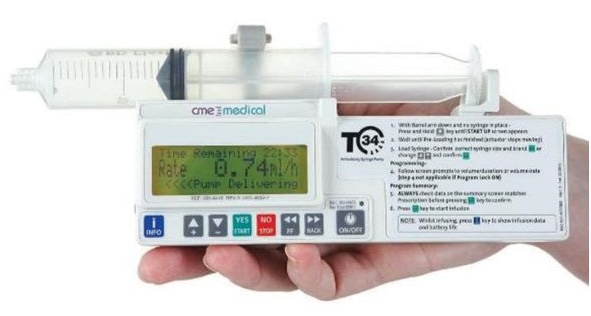
You’ll usually be given drugs in the least invasive way possible. This means they’ll be given in a way that causes the least amount of discomfort, pain or distress. The first step is to take them by mouth (orally). If this is not possible – for example, if you’re vomiting or cannot swallow – painkillers can be given, either through an injection under the skin (subcutaneous), through an injection into the muscle, (intramuscular), directly into a vein (intravenous). Sometimes a small battery-operated pump called a syringe driver is used to give medicine continuously under the skin for a period of time, such as 24 hours. You might be offered a syringe driver if you cannot take medicine by mouth – for example, if you’re being sick or have difficulty swallowing, or your symptoms can’t be managed with tablets or injections, or if your body can’t absorb medicines properly.
Some people are concerned that having a syringe driver can make death come sooner. There is no evidence to suggest that this is true. Syringe drivers are often used at the end of life because they are the easiest way to give someone the medicines they need to feel comfortable at that time.
How long will you need the driver for?
Syringe drivers are often used in the last few weeks and days of life but they can be useful for managing symptoms at any stage. Some people just use them for a short time to manage their symptoms. For example, syringe drivers can be very useful for taking anti-sickness medicines alongside chemotherapy.
Using a syringe driver
Your syringe driver will be set up for you by your doctor or nurse. It is usually set to give you your medicines continuously over 24 hours. The medicines will be changed or topped up each day by your nurse. Your nurse will change the needle every few days.
It might hurt a little bit when your nurse puts the needle under your skin, but after that, having a syringe driver should be painless. The medicines take three to four hours to reach a steady level in your body so you might not feel an effect straight away. Your syringe driver will have an inbuilt computer and a small screen. It calculates the rate at which the medicines you’ve been prescribed should be given and displays this on the screen. Having your medicines in a syringe driver shouldn’t make you any less mobile than before. If you are active, you can carry it around with you in a special bag.
The syringe in the syringe driver is attached to a needle or thin piece of tubing attached at the other end. The nurse will insert the needle just under the skin in your;
- Chest
- Tummy
- Top of your arm or leg
- Back such as over the shoulder blade
It will secure the tubing in place with a clear dressing. Once the needle and tubing is in place, you should not feel this and this can stay in place for a number of days.
Some people find it useful to tuck the syringe driver under their pillow at night to stop it from falling out of bed.
Dos and Don'ts
DO:
- Report any soreness, redness or swelling at the needle site to your nurse
- Contact the nurse if the needle accidentally comes out
- Contact your nurse or doctor if you have any concerns regarding your syringe driver or medication
- Keep the syringe contents out of direct sunlight and do not allow the syringe drive to become too warm
- Take care when walking around with the syringe driver, use the holster provided or put the syringe driver in your pocket
- Please ask your nurse for advice on the best place to keep your driver
- Always keep all drugs away from children preferably in a locked cupboard
DO NOT:
- Immerse the syringe driver in water; you can have a bath or shower but try to keep the needle site dry and keep the syringe driver out of the water by putting it on a stool by the bath or shower
- Do not attempt to change the settings
- Place the syringe driver above the height of the needle
Things to report to your nurse
If the syringe driver is accidentally dropped, immersed in water or contaminated by fluids in any way, contact your nurse immediately as she/he will need to bring you a new syringe driver and return the other for inspection.
Alarms
The alarm will go off if there is a problem with the syringe driver. Let your nurse know so they can come and check it. An alarm may just mean it needs a new battery. Your nurse will supply batteries and you should be left with a spare one. The driver display will alert you if there are any blockages or leaks. Blockages can happen if you accidentally lie on one of the tubes, for example.
Sources:
www.nhs.co.uk
Please contact your nurse who will come collect the syringe driver from you when it is no longer needed. If you have any questions or concerns about your syringe driver please talk to your doctor or call one of our nurses on the number below.
Download a pdf of this resource; Syringe drivers